
Ken G's Journal
Home Page: Ken G


East Windsor, NJ, USA
| Total Posts: 101 | Latest Post: 2026-04-17 |
| Table of Contents | RSS Feed |
PXL 20220515 222033609

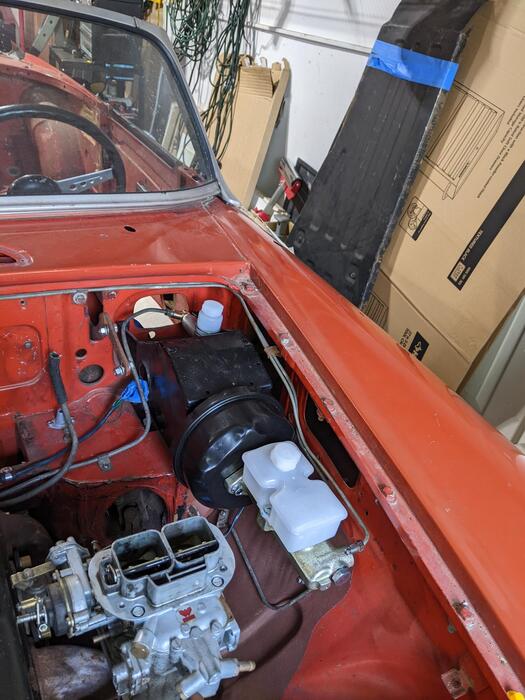
I have two dash harness available a 76 and a 80 harness. I started first with the 76 and ran into a minor issue. the headlight switch is wired into the 76 dash harness where on the 80 it is in the main harness.
This gave me three wires in the dash harness going to the light switch that I would need to rewire to their proper location. So I decided to switch to the 80 dash harness. This is working well with only a minor obstacles:
- The 76 steering cowl does not have a location for the light switch, but as was pointed out by V8MGBV8 the wires are long enough I can move the switch to the dash.
- The hazard switch for the 1980 car has the same pin out as the 76 car BUT the switch is a lot smaller so I need to get a proper sized switch.
- The fan switch for the 76 is larger and has a different pin layout than the 80 switch, so I need to figure out how to get the smaller switch into the bigger hole. I may get a blank and mount the switch in that. I'm not really worried about it now as I have done a heater delete so the switch will have nothing behind it anyways. It may end up being a manual switch for an electric radiator fan.
- The 80 dash has a brake warning light where the 76 dash has a brake switch. I plan on removing the switch and mounting the light someplace.
- The dimmer switch was not working so I've hard wired it together adding a 10 amp fuse
I also replaced the dash bulbs with LED's,
The next goal is to get the dash back into the car and hooked up and finish off the rest of the harness connections.
PXL 20220619 202652949
No comments have been posted yet...
Want to leave a comment or ask the owner a question?
Sign in or register a new account — it's free
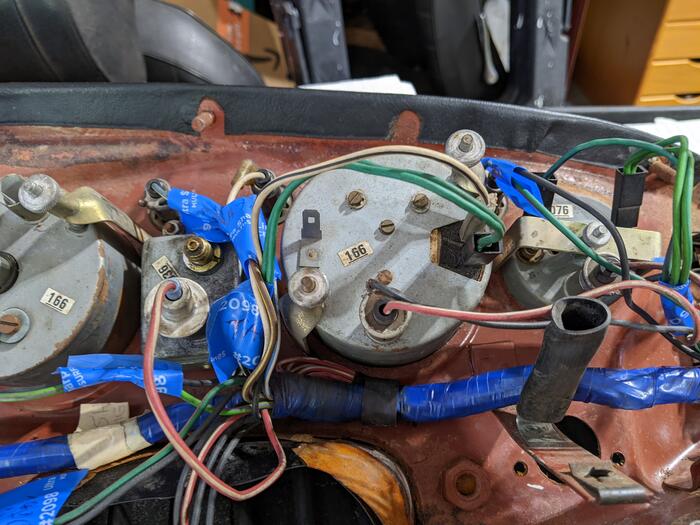
I need to do some testing on the fuel pump to see it it needs refurbishment or replacement.
With the tank out of the way and the dash installed I felt it was time to run the new trunk harness up to the engine compartment. Eight or the 9 wires matched up as expected, however I had one that I need to double check. The color on the main harness is not what I expected at the tie in point and I want to make sure I'm plugging it in correctly.
Oh one thing I did realize is that I forgot to run the oil pressure tube from the gauge to the switch. So Big OOPS there and it means I have to pull out the dash to get that set up properly.
I am feeling that the engine test is going to be happening soon, I'll be ordering a new fuel tank and exhaust system. Once those get in, things will come together quickly (I hope!)
No comments have been posted yet...
Want to leave a comment or ask the owner a question?
Sign in or register a new account — it's free
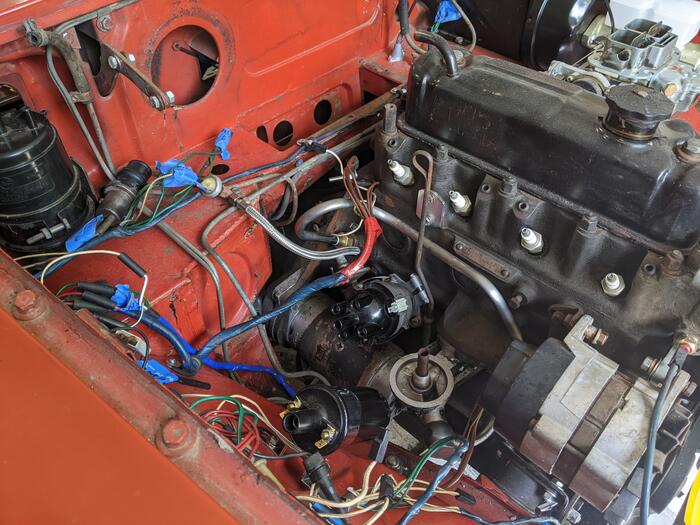
Installed the oil pressure tube, the speedometer cable, the steering wheel cowling and the accelerator cable on the inside of the car.
In the engine compartment I connected the rear wire harness, installed the oil filter bracket, connected the oil return pipe, set up the alternator and fan belt, replaced the temperature sending unit, installed the distributor and replaced the starter relay.
A couple of good days, and I feel like I'm making some real progress.
PXL 20220704 200947134
No comments have been posted yet...
Want to leave a comment or ask the owner a question?
Sign in or register a new account — it's free
I've got the new fuel tank, fuel pump and exhaust system on order, installed the fuel line and filter to the carb. Installed the accelerator cable, oil filter, and a few other minor things.
the list of things to do is still quite long but I am getting closer to the start testing, maybe two weekends away.
This is a wiring diagram of the rear wire harness I drew up a while ago, just putting it here for reference if it can help anyone out. (I want to complete this for the dash and main harness as time permits.)
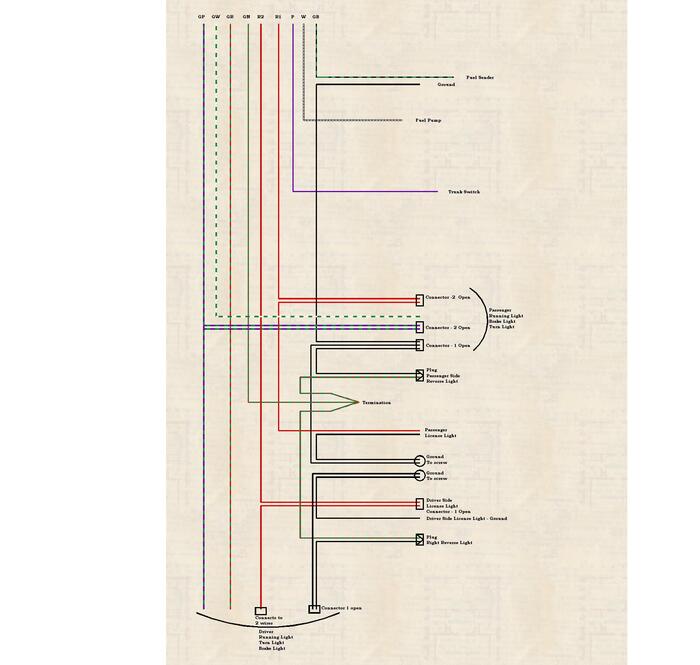
mgb rear wire
No comments have been posted yet...
Want to leave a comment or ask the owner a question?
Sign in or register a new account — it's free
 Make sure you know what you are doing.
Be safe when working on and under your car, JACK securely
Note: Be sure to label and bag the parts, nuts and bolts as you take them off the car. Keep a list of items you need to replace so you can make a single parts order.
1. Loosen the lug nuts (13/16) on the front tires.
2. Jack up car using the front cross member.
3. Properly support front of car using jack stands on the main rails.
4. Ensure that it does not move while on stands.
5. Remove the lug nuts the rest of the way and take off the tire.
6. Using a wrench and hammer turning clockwise loosen the lock nut (7/8) on the steering tie rod.
7. Remove the bolt (5/8-11/16) connecting the front sway bar to the A-frame on both the driver and passenger sides. Remove the 4 bolts (1/2) holding the 2 brackets and their bushings to the cross member and remove it for now.
8. Place a container under the brake line to catch brake fluid.
9. Using a (9/16) flare nut wrench loosen the brake line nut from the hardline to the rubber line.
10. After it is done dripping tape a cloth on the end of the line to stop intermittent dripping.
11. Using box wrenches (9/16 – 5/8) undo the nut and star washer holding the rubber brake hose to the bracket. Return the nut and washer on the rubber line for safe keeping.
12. Using a hammer and punch flatten the retainer bracket that is holding the 2 bolts on the back of the brake cylinder.
13. Remove the two bolts (5/8) from the back of the brake cylinder, and the cylinder will come free.
14. Replace the bolts into the cylinder for safe keeping.
15. Remove the center grease cap by using a small screw driver and carefully tap and pry the cap off.
16. Clean the grease off of the cap and the castle nut in the center of the hub.
17. Remove the cotter pin that is securing the castle nut by using a small screw driver.
18. Remove the castle nut ( 1 1/8) using a socket.
19. Carefully remove the spacer and bearing from the hub, clean the grease.
20. Place a tray under the hub to catch any parts that may drop and pull the hub out from the spindle.
21. Remove the four bolts (1/2) from the brake dust screen.
22. Replace the four bolts into the swivel axle to keep them safe.
23. Remove the bolt (11/16) on the bottom of the steering tie rod and using a ball joint separator, separate the tie rod end from the swivel axle. (If you remove the tie rod ends from the tie rods you must count and record the number of turns to remove it.)
24. Place floor jacks under the A frames and raise the arms up to compress the spring and remove the tension. (Be very careful)
25. Remove the cotter pin and castle nut (11/16) and drift the top pin (fulcrum pin has a half cut head) the holds the swivel axle to the front shock arm
26. Slowly let the floor jack down to release the tension on the spring. The A frame should drop all the way down and allow the spring to fall out.
27. Remove the cotter pin and castle nut (3/4 – 3/4) on the bottom bolt holding the swivel axle to the A frame. Separate the A frame out. This is heavier than it looks. Keep trak of the washers, support, seals, distance tube and other parts of this.
28. Remove the nut (3/4) that connects the sway bar link to the front wishbone arm.
29. Remove the three bolts (1/2 – 9/16) that connect the wishbone arms to the spring pan.
30. The spring pan is loose and can be removed now.
31. Remove the nut (3/4) and washer that connect to front wishbone arm to the pivot and take off the wishbone. Place the nuts and washers back on the pivot.
32. Remove the nut (3/4) and washer that connect to rear wishbone arm to the pivot and take off the wishbone. Place the nuts and washers back on the pivot.
33. There are 4 bolts (9/16) with washers holding the shock to the cross member. Remove these and pull out the shock.
34. Complete steps 6-33 for both sides.
35. Removal of the steering rack. Turn the steering wheel to the full right, (Passenger side) and using paint or white out mark where the steering spines on the Pinion meet the steering UJOINT.
36. Remove the 4 bolts (1/2) that hold the steering rack to the cross member. Be careful to watch for alignment shims that may drop out.
37. Fully remove the bolt (1/2 – 1/2) holding the steering pinion to the steering UJOINT. This was very difficult for me to remove and I needed to use a gear pulling and drift pin.
38. Press the steering rack forward to remove it from the UJOINT, Be careful to not pull the UJOINT forward and separate the steering column I’m not sure how to better explain this so you may need to do more research to understand this.
39. Pull the intact steering rack forward to remove.
40. Place a floor jack under the cross member to support it for removal. I also place a support (ramps) on either side of the jack for balance it needed.
41. From the top remove the 4 nuts (11/16) that hold the cross member to the rails in the engine compartment.
42. When all 4 nuts are loosen you can knock them out the pins from the top down and slowly lower the floor jack and the cross member should lower.
43. With the cross member out of the car you can remove the final parts of the front suspension from it.
44. Remove the 4 bolts (9/16 – 9/16) holding each of the pivots to the cross member, Mark the pivots to remember the correct side for replacement.
45. Remove the 2 bolts (7/16 – 7/16) holding the Spigot (spring locator) to the cross member on each side.
46. Remove the two bolts (1/2 – 1/2) holding the shock buffer to the aluminum distance piece to the cross member. I needed to remove the nuts pull the whole unit from the cross member and then place the buffer and distance pieces in the vice to remove the bolts. The bolts were corroded into the aluminum and would not give easily.
No comments have been posted yet...
Want to leave a comment or ask the owner a question?
Sign in or register a new account — it's free




No comments have been posted yet...
Want to leave a comment or ask the owner a question?
Sign in or register a new account — it's free